France Student Protests
FRANCE ON EDGE: 70,000 SECURITY PERSONNEL DEPLOY AS PROTESTS TEST MACRON GOVERNMENT
Student anger over deteriorating education conditions has evolved into a wider confrontation over the cost of living, public order and the right to protest — six months before France’s presidential election.
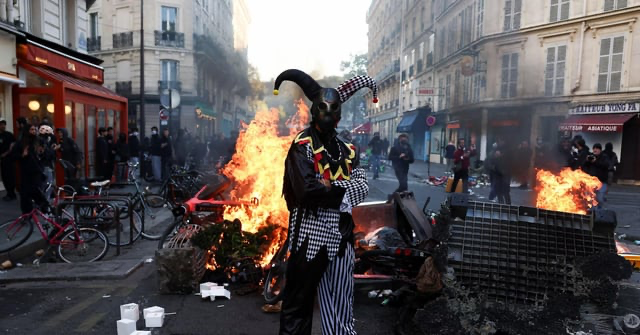
France is bracing for another round of nationwide demonstrations, with authorities deploying approximately 70,000 police officers and gendarmes as the government attempts to prevent a repeat of last weekend’s widespread violence and looting.
What began as student-led protests over deteriorating school infrastructure, teacher shortages and university admissions has expanded into a broader expression of public discontent over living costs, inequality and President Emmanuel Macron’s leadership.
The latest mobilisation places France’s security apparatus under considerable pressure at a politically sensitive moment, with a presidential election approaching in 2027.
##SECURITY SURGE, CIVIL LIBERTIES UNDER SCRUTINY
Interior Minister Laurent Nuñez has announced a security deployment approximately 20 percent larger than that used during the previous weekend’s unrest. Specialist intervention unit RAID is also expected to support police operations, although it will not directly undertake routine crowd control.
The measures follow the violence of October 17, when demonstrations that were initially largely peaceful were accompanied by looting, vandalism and clashes. Official figures cited by Al Jazeera indicate that more than 2,000 people were taken into police custody.
Authorities have imposed restrictions on demonstrations in several cities, including parts of Montpellier, Rouen, Nice and Lyon. In Paris, a planned union-led march was redirected from its originally negotiated route, triggering objections from organisers.
Amnesty International France has warned that the security escalation threatens the right to peaceful assembly. The dispute highlights a central dilemma for the French government: preventing violence without undermining the civil liberties it is responsible for protecting.
##FROM SCHOOL GATES TO A NATIONAL PROTEST MOVEMENT
The demonstrations began in mid-September, when high school students blocked access to schools in protest against what they described as deteriorating educational conditions and an unfair university admissions system.
The movement has since drawn in groups concerned about the rising cost of living, inequality and the direction of the country under Macron.
On Friday, Macron met representatives of the student movement and promised additional teachers and a major overhaul of Parcoursup, the university admissions system. Student representatives, however, called for further mobilisation until concrete proposals are delivered.
The government’s challenge is no longer simply one of crowd control. It must also demonstrate that political engagement can produce tangible responses to the grievances driving the protests.
##THE ELECTORAL DIMENSION
The unrest comes roughly six months before France’s next presidential election, expected in 2027. Macron cannot seek an immediate third consecutive term, making the political consequences of the current crisis particularly significant for the country’s next leadership contest.
Marine Le Pen’s far-right National Rally is seeking to capitalise on public concerns over law and order. The party is holding its congress in Orléans, where authorities anticipate a substantial counter-demonstration and have prepared a separate security operation.
The intersection of nationwide protests, public-order concerns and intensifying electoral competition could reshape the political debate in the months ahead.
For the far right, the unrest offers an opportunity to reinforce its law-and-order message. For the government and other political forces, the challenge is to address legitimate public grievances while drawing a clear distinction between peaceful protest and criminal violence.
##RAISINA WIRE ANALYSIS
France’s immediate test is operational: whether a massive security deployment can prevent another outbreak of violence. Its deeper test is political.
A state can reinforce streets, restrict routes and mobilise specialist units. It cannot resolve dissatisfaction over education, affordability and inequality through policing alone.
At the same time, violence and looting risk weakening public support for the very demonstrations that brought these issues into national focus. Restrictions on peaceful assembly, meanwhile, risk deepening distrust if citizens believe that security measures are being used too broadly.
The coming months will therefore test the government’s ability to balance public order, democratic freedoms and credible policy responses.
The strategic question for Paris is whether it can restore public confidence before domestic unrest becomes a defining issue of the 2027 presidential campaign.