Eastern India · Strategy
The “Iron Dome” of the East: Why Kolkata is Becoming India’s Strategic Nerve Center for 2026
Kolkata is no longer in the rear. It is the command, intelligence and logistical anchor that ensures the frontlines move forward.
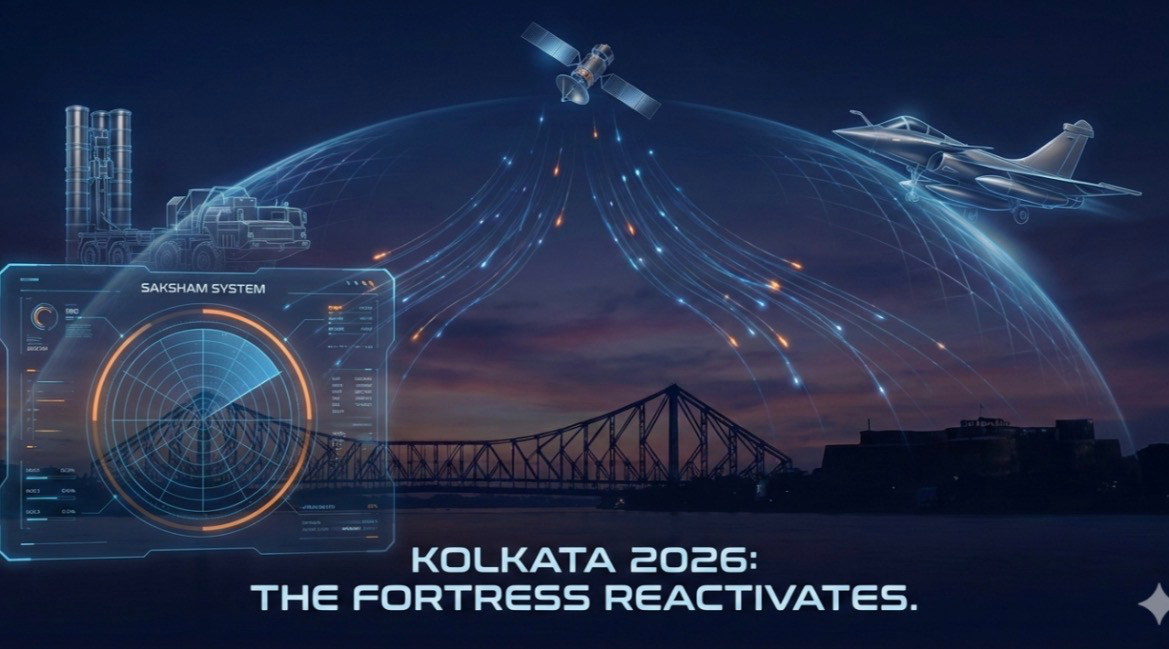
For decades, Kolkata was viewed through the lens of history, culture, and intellectualism—a “Peace Station” far removed from the volatile friction points of the Himalayas or the Thar Desert. But as of February 2026, the strategic map of India has been redrawn. Kolkata has officially “re-activated.”
The city is no longer a dormant administrative center; it has evolved into a hardened, digitally-networked Integrated Forward Hub. From AI-powered drone shields to underground strategic rail lines, here is why the “City of Joy” is now the “Fortress of the East.”
1. The Australia Connection: A Blueprint for “Jointness”
The catalyst for this transformation is currently unfolding thousands of miles away. India’s Chief of the Army Staff, General Upendra Dwivedi, is in Australia (Feb 16–19, 2026) to finalize the “Australian Model” for India’s own Integrated Theatre Commands (ITC).
This isn’t just a standard diplomatic visit. General Dwivedi and Australian Army Chief Lt. Gen. Simon Stuart were classmates at the US Army War College (Class of 2015). This personal bond is being leveraged to bypass bureaucratic friction and deep-dive into the Headquarters Joint Operations Command (HQJOC) —the exact template India is using to integrate Land, Sea, and Air assets under a single “brain” in the Bengal sector.
2. The “Sudarshan Chakra” Shield: A Multi-Layered Fortress
To secure the eastern flank, India has deployed what military analysts are calling the “Sudarshan Chakra” Matrix — a multi-layered Anti-Access/Area Denial (A2/AD) bubble:
- The Outer Shield: S-400 Triumf systems stationed near Siliguri now monitor airspace 400km deep into Tibet and Bangladesh.
- The Supersonic Spear: Mobile BrahMos ER units in the Siliguri-Chopra axis provide precision strike capabilities against high-value targets in the Chumbi Valley.
- The Air Umbrella: Rafale squadrons from Hasimara are now digitally linked to Kolkata’s command center, ensuring a 10-minute response time for the city’s defense.
3. SAKSHAM: The AI Shield Against Asymmetric Threats
The most immediate 2026 threat isn’t just missiles—it’s asymmetric drone incursions. To protect the “Integrated Brain” at Fort William, the Indian Army has deployed the SAKSHAM system.
Developed with Bharat Electronics Limited (BEL), SAKSHAM is an AI-powered command-and-control platform that creates a Recognised UAS Picture (RUP), tracking up to 20 drones simultaneously. If a rogue drone is detected, the response is instantaneous:
- Soft-Kill: The IG T-Shul Pulse jams GPS and radio links.
- Hard-Kill: The DRDO IDD&IS Mk-II uses a 10-kilowatt laser to physically burn through drone electronics at a 2 km range.
- Swarm Defense: The newly formed Bhairav Battalions use the Bhargavastra system to break up incoming drone swarms.
4. Why Now? The Bangladesh Factor and the “Chicken’s Neck”
The shift from “Peace Station” to “Forward Base” is driven by two geopolitical realities:
- 1. The Bangladesh Transition: Following the return of a BNP-led government and increasing radical influence in Dhaka (Feb 2026), India’s eastern border is no longer considered “benign”.
- 2. Hardening the Corridor: Kolkata now serves as the logistical “Shoulder” for the Siliguri Corridor (the “Chicken’s Neck”). To ensure this vital artery cannot be choked, a 35.7 km underground strategic rail tunnel has been sanctioned. This “invisible supply line” allows tanks and heavy artillery to move from Kolkata to the Northeast, shielded from Chinese artillery.
5. The Maritime Pivot: Haldia as a Naval Forward Base
Kolkata is no longer just “Army land”. The Navy has operationalized Haldia as a forward logistics base for the Maritime Theatre Command. This allows India to project power directly into the northern Bay of Bengal, monitoring foreign “research vessels” and securing vital sea lines of communication.
The Bottom Line
By the time General Dwivedi returns from Australia, the transformation of Kolkata into a Joint Military Station will be complete. The city has evolved into an Active Integrated Fortress —a “coiled spring” equipped with data-centric warfare capabilities, ready to respond to any threat from the Himalayas to the Bay of Bengal.
Kolkata is no longer in the rear. It is the command, intelligence, and logistical anchor that ensures the frontlines move forward.