India US Strategic Ties
US State Secretary visits Jamnagar Refinery: Energy in Focus
Rubio’s Unusual India Visit Signals a Changing India–US Equation: Strategy Gives Way to Transactions?
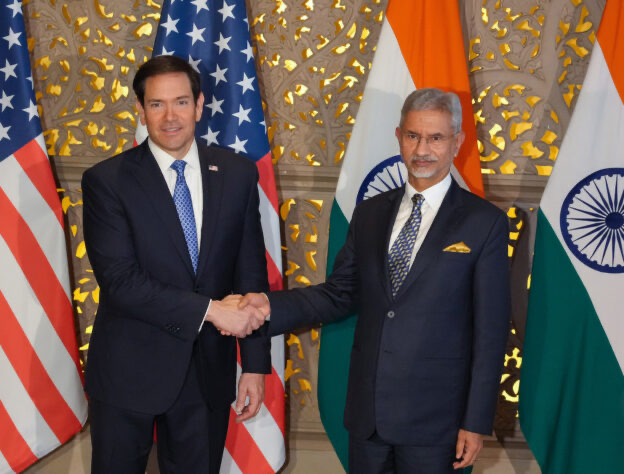
The geography of diplomacy can sometimes reveal more than its official statements. When US Secretary of State Marco Rubio travelled to India on October 20–21, his itinerary departed from the conventional script of high-level bilateral engagement. Rather than making New Delhi the centrepiece of his visit, Rubio focused on Mumbai’s corporate powerhouses and the sprawling refining complex at Jamnagar in Gujarat.
The choice of destinations raises a larger geopolitical question: is Washington beginning to redefine its partnership with India around immediate commercial interests, energy procurement and business-to-business arrangements, rather than the wider strategic convergence that has underpinned bilateral relations for more than two decades?
Rubio’s visit did not formally end the India–US strategic partnership. Nor does a single itinerary establish a fundamental change in American policy. But the emphasis on industrial capacity, private investment and energy flows offers a revealing snapshot of how the relationship is being managed under US President Donald Trump’s second administration.
For New Delhi, the distinction matters. India wants access to American technology, defence systems, investment and markets. Washington, meanwhile, wants greater access to India’s enormous consumer market, deeper commercial engagement with Indian conglomerates and a larger role for American energy suppliers. The interests overlap—but they are not necessarily identical.
A diplomatic itinerary with a commercial centre of gravity
Rubio’s two-day programme began in Mumbai, where he met External Affairs Minister S. Jaishankar and participated in a trilateral discussion with Jaishankar and UAE Foreign Minister Sheikh Abdullah bin Zayed Al Nahyan. He also engaged with leading Indian business figures, including representatives of the Tata, Adani and Reliance groups, before travelling to Jamnagar.
The absence of New Delhi from the itinerary was notable because a visit by a senior American official would ordinarily be expected to include an engagement with Prime Minister Narendra Modi. The format did not, however, mean that official diplomacy had been abandoned: Rubio held bilateral talks with Jaishankar, and the two governments continued discussions on trade, defence, technology and energy security.
The more significant signal lay in the balance of attention. Corporate boardrooms and an industrial facility occupied a prominent place in the programme, highlighting the importance of private-sector actors in the current bilateral equation.
This approach is consistent with the transactional outlook associated with the Trump administration. Partnerships are increasingly presented through tangible economic outcomes: investment commitments, purchases, market access, manufacturing and jobs.
The question is whether this transactional approach can coexist with a long-term strategic partnership—or whether it risks reducing a complex geopolitical relationship to a sequence of commercial bargains.
The energy question: Why Jamnagar matters
Rubio’s visit to Reliance Industries’ Jamnagar refinery brought energy security into sharp focus. The facility is among the world’s largest refining complexes and has the technical capacity to process a broad range of crude oils, including heavy grades that many conventional refineries cannot handle efficiently.
Washington has been encouraging India to diversify its energy procurement and expand purchases from American suppliers. During the visit, Rubio also promoted the possibility of Indian refining capacity being used to process additional Venezuelan crude.
The proposal has an obvious commercial logic. India possesses sophisticated refining infrastructure, while American policy is seeking new outlets for oil supplies and greater participation by US-aligned businesses in global energy flows. A closer arrangement could benefit refiners, traders and energy companies on both sides.
But the geopolitical implications are more complicated.
India imports the overwhelming majority of the crude oil it consumes. Its energy strategy has traditionally prioritised supply security, competitive pricing and flexibility in choosing suppliers. Russian crude became a significant component of that strategy after the outbreak of the Ukraine war in 2022, partly because discounted supplies offered Indian refiners commercial advantages.
Washington has repeatedly sought to influence India’s energy choices, particularly where Russian oil is concerned. Yet energy markets cannot be reorganised by diplomatic preference alone. Freight costs, refinery compatibility, insurance, sanctions exposure, payment mechanisms and the reliability of supply all influence purchasing decisions.
Venezuelan heavy crude may offer opportunities for specialised Indian refineries, but its viability depends on commercial terms and the regulatory environment. It cannot automatically replace Russian supplies simply because such a shift would suit American policy objectives.
The central issue for India is therefore not whether it should buy more American or Venezuelan oil. It is whether any new arrangement improves the country’s energy security and economic interests without creating a different form of external dependence.
Trade: The promise of a deal that remains unfinished
Trade negotiations remain another major fault line in the relationship.
The two governments have been working towards a bilateral trade agreement, but prolonged negotiations and US tariff measures have complicated the broader political atmosphere. The dispute has exposed a basic tension: Washington wants greater access to Indian markets and more favourable terms for American businesses, while New Delhi must balance those demands against domestic economic priorities and the interests of Indian producers.
During his visit, Rubio expressed confidence that the agreement was close to completion, describing the remaining distance in optimistic terms. Similar assurances had been made previously, however, and the negotiations had yet to produce a completed agreement at the time of the visit.
That gap between diplomatic reassurance and a signed deal is important. An agreement could provide businesses with greater certainty, support investment and reduce friction in the relationship. Until its terms are finalised, however, expectations should not be mistaken for an outcome.
For India, the details will matter more than the announcements. Tariff schedules, market-access commitments, sectoral exemptions, regulatory protections and implementation mechanisms will determine whether the agreement produces balanced gains.
For Washington, an agreement would demonstrate that the administration can translate pressure and negotiations into commercial results. For New Delhi, the challenge is to secure a settlement that advances Indian interests rather than simply resolving a political irritant on American terms.
The corporate dimension: Private companies become strategic actors
The prominence of India’s major conglomerates during Rubio’s visit reflects a broader feature of contemporary geopolitics: economic power and foreign policy are increasingly intertwined.
Large Indian businesses can provide access to markets, manufacturing capabilities, energy infrastructure and investment capital at a scale that governments cannot easily replicate. For Washington, engaging these companies can be a practical way to pursue economic objectives while keeping diplomatic channels open.
The proposed American refining investment associated with Reliance adds another dimension to this relationship. If realised, such projects could deepen industrial links, support employment and create incentives for continued cooperation.
However, corporate gains and national strategic gains are not automatically the same thing.
A private company will generally evaluate an opportunity through expected returns, regulatory risk and commercial viability. A government must also consider supply resilience, diplomatic leverage, industrial policy and the long-term consequences of dependence on a particular partner.
India therefore needs to assess major commercial arrangements not only in terms of investment figures or export opportunities, but also in terms of what they contribute to national capacity and strategic flexibility.
The China factor—and the limits of strategic convergence
The India–US partnership has expanded substantially through defence cooperation, technology initiatives and coordination in the Indo-Pacific. Shared concerns about China’s growing power have helped sustain this engagement despite differences between the two countries.
Yet the relationship has never been a formal alliance. India continues to emphasise strategic autonomy and maintains relationships with countries that Washington regards as competitors or adversaries. New Delhi’s approach is built around retaining room for manoeuvre rather than aligning automatically with one major power.
The Trump administration’s transactional approach may intensify this tension. If Washington evaluates India primarily as a counterweight to China when strategically convenient, but applies commercial pressure when negotiating trade or energy issues, New Delhi will have reason to question the durability of the partnership.
At the same time, India cannot assume that every American commercial demand represents a strategic threat. Greater energy trade, technology cooperation and private investment can generate genuine benefits when they are mutually advantageous and supported by predictable rules.
The task is to distinguish cooperation that strengthens India’s capabilities from arrangements that primarily serve short-term political or commercial objectives in Washington.
What India should watch next
Three indicators will help determine whether Rubio’s visit marks a lasting shift or simply reflects the administration’s negotiating style.
First, the trade agreement. A completed and balanced agreement would provide evidence that the two governments can move beyond public assurances and resolve difficult economic questions.
Second, energy procurement. The key test will be whether any expansion of American or Venezuelan crude purchases occurs on commercially competitive terms and strengthens India’s supply resilience.
Third, the strategic agenda. Defence cooperation, advanced technology, civil nuclear engagement and Indo-Pacific coordination will indicate whether the wider partnership remains substantive beyond energy and corporate transactions.
The treatment of India in Washington’s regional diplomacy will also matter. New Delhi will continue to assess how American engagement with Pakistan, China and other regional actors affects Indian security interests.
A partnership at a crossroads?
Rubio’s visit is best understood not as proof that the India–US strategic partnership has collapsed, but as evidence that its operating logic is under pressure.
The relationship still has substantial foundations: shared concerns in the Indo-Pacific, economic complementarity, technological cooperation, defence engagement and extensive people-to-people links. These interests are not erased by a commercially focused diplomatic itinerary.
Nevertheless, the emphasis on Mumbai’s corporate establishments and Jamnagar’s refinery suggests that immediate transactions are becoming more visible in the management of bilateral ties. The risk for India is that strategic cooperation becomes conditional on delivering commercial concessions, while American policy remains vulnerable to shifts in domestic political priorities.
New Delhi’s response need not be confrontation. It should be calibrated engagement: negotiate firmly, diversify energy supplies, seek predictable trade rules and ensure that private-sector opportunities reinforce national capabilities.
Ultimately, the measure of a strategic partnership is not the number of meetings held or the scale of business commitments announced. It is whether both countries can sustain cooperation when their immediate interests diverge.
Rubio’s visit has brought that test into sharper focus. For India, the challenge is to make American commercial interest work in India’s strategic interest—without allowing the relationship to be defined by transactions alone.